

let’s talk about money
Lately I’ve been seeing freelance writers and creatives I follow being super transparent about their finances, how much they make, how they earn their living, how it’s possible for them to be a freelancer, etc. Money is one of the most uncomfortable things to talk about lol—but I wanted to offer transparency on my end too, as I find it so helpful when writers talk about how they actually make a living. Of course, I wish we had better systems in place to support artists and writers (for example, the U.S. should do what Ireland does and have a basic income for artists!)
Before I get into what I’m doing now, I wanted to offer some background: I grew up middle-class in a house in the suburbs with my mom and dad and sister. Growing up, my dad worked in the parking industry, managing and running parking lots in Denver, and my mom ran an art business, teaching after-school art classes and summer camps. She also occasionally picked up freelance projects for Mattel and Hasbro (she is an illustrator and toy designer). My mom has told me that though she doesn’t regret the work she did when my sister and I were kids, she always wished she could’ve focused on her own art. I’m so proud of her that she is doing that now—totally pouring into her art, illustrating children’s books, returning to projects she’s been itching to work on. She’s one of the people who has most encouraged me to prioritize my writing.
Saving money was incredibly important to my dad. We didn’t go on many vacations as a family (other than a long weekend in Salida every summer and visiting family). I babysat and nannied during the school year and summers and had other random jobs as a teenager. College was paid for with a scholarship I got and the 529 college savings plan my parents set up for me and my sister. We took out a relatively small loan to cover the rest. In college, I held various work-study jobs on campus during the school year and summers. My mom helped me pay for necessities I couldn’t afford on my own in college with what she made from her art business.
After I graduated college in May 2020, I moved to DC for a fellowship at Sojourners. The fellowship came with housing, health insurance, and grocery money (and a meager monthly stipend of $175 for spending money, which THANK GOD has now been raised to $700 for current fellows). Needless to say, I did not really make or save any money that year, but I didn’t really lose that much either, given that essentials were provided for and it was COVID so we couldn’t really do anything anyway.
After my year in DC, I had no idea where I was going or what I was going to do. I got an email about The Fireplace, a new intentional community in Chicago, and decided to move to live there. I got a part-time job at L’Arche Chicago which paid for rent and my expenses (I was paying $600 for rent at the time) and I tried stretching a bit into freelancing on days I wasn’t at L’Arche. So I was slowly saving some money, and able to work part-time, thanks to my living situation being affordable.
Then I left that job at L’Arche and got a part-time job at U.S. Catholic, 25 hours a week, and was making quite a bit more per hour, so I started paying more in rent to equal the 1/3 of what I make (I was paying about $850 in rent). I was also picking up more freelance work. Around this time, the pause on student loan payments stopped, and my parents learned that there was still a chunk of money left in the 529 account that could go toward paying loans, and they helped me pay off the rest of my loans before interest began accruing. This is something I’m really grateful for and that I recognize is a great privilege—to be debt free.
Fast forward to now—I am freelancing full-time, and the main reason I’m able to do that is because I live in an intentional community with extremely affordable rent. Our landlords are the Quakers, who own the big old house we live in, and our rent is heavily subsidized because we run the guest business for the Quakers. Two of the rooms in our home are guest rooms, and we, the residents of Sophia community, manage the business and keep everything in line for the guests. Our weekly chores also include cleaning spaces that the Quakers use.
The price of our rent depends on the size of our rooms. I live in one of the smallest rooms in the house (it is quite small, but I actually really like it) and my rent is about $135. We each pay $140 for groceries each month. Those are basically all my expenses to live in this house—other than chipping in for twice-yearly community retreats and the occasional appliance that needs replacing.
I had to calculate my estimated income for healthcare.gov the other day (a downside to not having a full-time job with an employer is that I pay for my own health insurance, a shitty BCBS plan), and since I started freelancing in July, I’ve averaged a monthly income of around $1300, coming from my writing and editing work and about 2 shifts a month at L’Arche. This is not a lot, but given that my rent is so cheap, I’m able to do it and still save money. I also sold my car (which was my grandma’s car before she died) so I’m no longer paying for car insurance and have quite a bit extra in my savings.
Since graduating college, I’ve only lived in communities. A lot can be said about the benefits of living in community, but a major one is finances and the money you’re able to save, not only on rent but on groceries and other living expenses. However, community can’t always be the answer (sometimes the cost of communal living isn’t the $$, but your mental health) and it isn’t for everyone—it’s also not good to be trapped in a situation you can’t get out of (I make it a point to have enough $ to afford a few months of rent elsewhere if I needed to move). I was lucky to be able to move out of one community and into a different one, mostly because my partner Greg has lived in Sophia community for a while, and I had already gotten to know the people here, which gave me a leg up in my application. All this has made me reflect on the fact that community is a kind of privilege, but it’s also a risk, and each community is so different that it’s hard to even make generalized statements like that.
I don’t know if I could keep freelancing if I moved out of Sophia community. But for now, I’m really grateful and I’m in no rush to change the situation. I’m seeing this season of life as an opportunity to really focus and dedicate myself to my writing and to discerning what comes next for me in life. I hope this transparency was helpful in some sort of way, and I’m grateful for other writers who have been transparent. We need affordable housing and we need good universal health care and we need so many other things.
Thanks for reading this brain dump—always open to more conversation around this too.
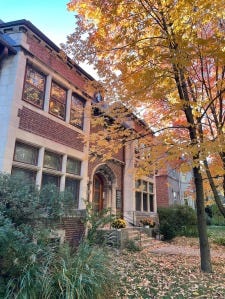
Sophia community/Quaker house